
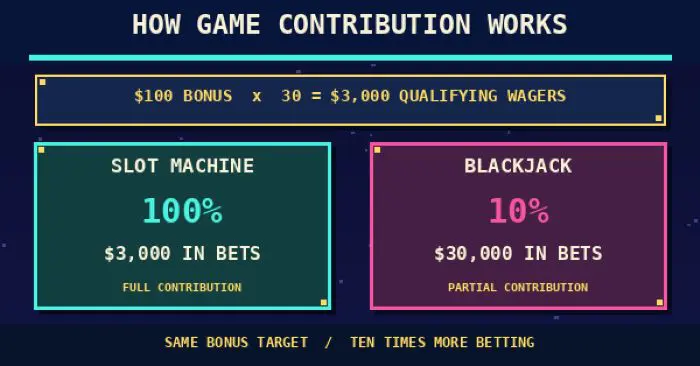
I’ve seen claims of a $100 “free” bonus with a 30x wagering requirement. I sat down at Blackjack, knowing that was the only game I could play effectively. I then went through what seemed like hundreds of hands. After checking the wagering tracker, I saw it had barely moved. All systems were go; everything was normal. However, it was then that I ran into the Rule that will ruin your day and will cause confusion: Game Weighting. In the terms and conditions section of a bonus, it states how much each type of bet contributes to your required wagering. For example, a $10 bet that has 100% Game Weighting reduces the required wagering by $10. On the other hand, a $10 bet that has 10% Game Weighting reduces the required wagering by $1. An excluded game results in a $10 bet having zero Game Weighting, which means the bet does nothing for reducing the required wagering.
As stated previously, the wagering requirement, also known as the wagering or roll-over or turn-over, is the total amount of wagers that you need to place in order to convert bonus funds or bonus winnings to withdrawable cash. Since a 30x wagering requirement on a $100 bonus requires $3,000 in bets, Game Weighting simply determines how quickly each real bet will reduce the overall wagering requirement. This is it; this is the entire system. While it seems to be straightforward on paper, the way it functions in reality greatly affects the true price of a bonus and most players fail to consider it until they are mid-session trying to determine why their progress bar appears to be frozen.
Game Weighting vs. Game contribution: same Rule, just different names
This Rule is referred to using a handful of names depending upon who publishes the information. Some refer to it as Game Weighting, while others call it game contribution, wagering contribution, contribution rate, or contribution percent. Regardless of the name, they all mean exactly the same thing. Some casinos provide a complete breakdown of their contribution percentages in their bonus terms and conditions. Other casinos may merely state that Slots contribute 100%, and all other games contribute 10%. Lastly, some casinos provide this information in their general terms and conditions.
Again, the nomenclature isn’t important. What’s essential is identifying the actual numbers associated with a particular offer you wish to accept since contribution rates are not standard throughout the gaming industry. Two casinos may offer nearly identical welcome packages yet assign different contributions towards their respective Blackjack games. Therefore, one casino may permit Blackjack at 10% while excluding it altogether at another casino. Additionally, an operator may alter contribution rates between its various promotional offerings. Thus, a reload package may not adhere to the same rules as the welcome package accepted several months prior.
Impact of contribution percentages on your wagering requirements
At this juncture, we see the misleading nature of the advertised multiplier start to manifest. A “10x wagering” headline looks relatively manageable. Nevertheless, that 10x assumption relies on your ability to play games that have a 100% contribution. If you shift to games that have a 10% contribution, you will require ten times as many dollars in real wagers to achieve your goal. Again, the bonus itself hasn’t changed. Your effective rollover has changed.
Why do Slots generally contribute 100% towards wagering?
There are two primary reasons for this phenomenon: house edge and variance.
House edge:
Casinos structure their Bonuses to ensure that players lose a significant portion of their bonus money during their attempts to clear them. Slots enable casinos to generate revenue based on these expectations.
Online Slots generally feature RTP values ranging from approximately 94% to 97%, resulting in house edges of approximately 3% to 6%.
Run a $100 bonus at 30x through a slot with an RTP of 96% and you can anticipate losing approximately $120 in excess of your original $100 bonus via $3,000 in wagers.
Not everyone experiences losses in excess of their bonus (there is considerable variability with regard to Slots), however from an operational standpoint, Slots act as the preferred method for players to attempt to clear Bonuses, thus allowing casinos to recover their bonus and additional funds.
The second reason why Slots receive full contribution is due to their lack of strategic elements that significantly impact the house edge. All players receive the exact same RTP irrespective of how they play, enabling casinos to predict player behavior when pricing promotional activities.
Why do Blackjack, Roulette & video poker receive reduced contributions?
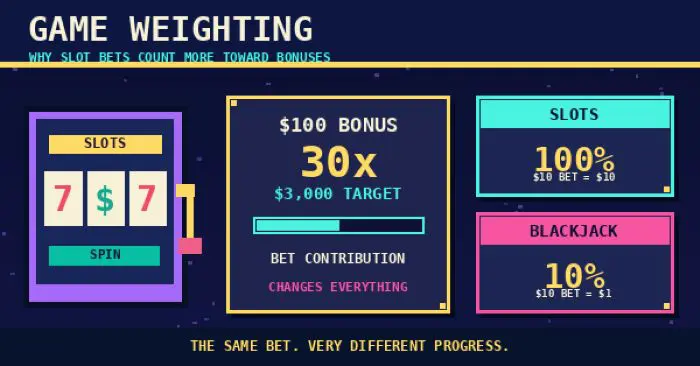
Conversely, let’s examine the opposite side of the equation. Blackjack is played utilizing basic strategy and boasts a house edge of approximately 0.5% assuming favorable rules; although this can fluctuate depending upon the specific table being utilized. Assuming Blackjack received 100% contribution Toward Wagering, a similar $3,000 in wagers would result in anticipated losses totaling around $15. Once clearing the requirement, players should retain roughly $85 of the original $100 bonus. This represents a bonus provided by the casino for players to utilize and is highly advantageous for casinos given large volumes of players participating in such programs.
Operators therefore adjust contributions downward in order to increase the expected losses associated with such low-house-edge games. If we reduce Blackjack contributions to 10%, the requirement shifts upward by a factor of 10. Based on an approximate house edge of 0.5%, an expected loss of around $75 would occur at 30k in bets. Given that both parties share the same expected outcome – i.e., the casino realizes profits from wagering – this demonstrates why table games consistently receive lower contributions Toward Wagering requirements.
Similar reasoning applies to other table games. Although Baccarat’s banker bet features a house edge of approximately 1.06% and the player bet features an approximate house edge of 1.24%, this translates into reduced or zero contributions for those games as well. Similarly, video poker tends to present substantial difficulties for operators. Optimized play on full-pay Jacks or Better yields an RTP of roughly 99.5%. Consequently, video poker is frequently assigned either zero contributions or 0%-20%.
Roulette is a somewhat unique situation compared to the aforementioned games. European Roulette has a house edge of approximately 2.7%, whereas American Roulette has a house edge of approximately 5.26%; neither is dramatically far removed from certain Slots.
Live dealer games – the most frequently excluded category
Live casino games are negatively affected the most regarding contribution percentages.
Given that live dealer games possess house edges consistent with their digital versions (live Blackjack features house edges comparable to digital Blackjack), along with substantially greater operating expenses (each table necessitates a real dealer, a studio, cameras and fees paid to license live dealers), it creates no financial sense for casinos to permit live dealer games with high margins while accepting bonus money.
Calculating your effective wagering requirement
Your effective wagering requirement can be calculated by dividing your advertised multipliers by your contribution percentage and multiplying by your wagering base. For example, a requirement of 30x @ 10% contribution equals an effective requirement of 300x. Multiplying that by your wagering base ($100) equates to $30,000 in total bets.
Which is the best game to use for clearing casino Bonuses?
Permitted Slots featuring 100% contribution Toward Wagering, sufficient RTP and suitable volatility for your Bankroll comprise the formula for success. Lower volatility Slots generally assist with keeping your Bankroll intact longer during extended periods of rolling over.
Another fact worth noting is that occasionally the correct decision is to bypass a bonus altogether. If you primarily play Blackjack or live tables, a bonus offering a mere 10% contribution Toward Wagering can transform an enjoyable experience into an unwelcome grind that includes constraints imposed by time limits and maximum bet limits. Wagering with your own money provides unlimited freedom without any risks of forfeiting potential earnings and/or withdrawing your funds at any time.
Lower cashback or lower wagering reloads frequently prove Better options than larger welcome Bonuses that you’ll likely never realistically clear.
Frequently Asked Questions
Q: What does “Game Weighting” represent in casino Bonuses?
A: It represents the proportionate amount each bet contributes toward your required wagering. A bet that receives 100% Game Weighting will reduce your required wagering by $x (where x represents the size of the bet). Conversely, a bet receiving 10% Game Weighting will reduce your required wagering by $0.x (where x again represents the size of the bet).
Q: Does “game contribution”, “wagering contribution”, “contribution rate”, “contribution %”, etc., represent anything different than “Game Weighting”?
A: No – “game contribution”, “wagering contribution”, “contribution rate”, “contribution %” represent nothing different than “Game Weighting”.
Q: Why do Slots clear Bonuses faster than table games?
A: Slots generally clear Bonuses faster than table games because Slots generally receive 100% contributions toward Wagering requirements, whereas table games generally receive much lower contributions (i.e., anywhere between 0% and 20%).
Q: Do all Slots receive full contributions Toward Wagering requirements?
A: No – certain high-RTP Slots; progressive-jackpot-Slots; and Slots offering buy-in-bonus features are examples of Slots that do not receive full contributions toward Wagering requirements.
Q: Will Blackjack receive contributions Toward Wagering requirements?
A: Yes – but generally only at a reduced rate somewhere between 0% and 20%. Due to the extremely low house edge when utilizing basic strategy; many casinos exclude Blackjack entirely from bonus eligibility.
Q: Will Baccarat or video poker receive contributions Toward Wagering requirements?
A: Both types of games generally receive contributions in the range of 0% – 20%. Due to their low-house-edge characteristics (approximately 1% on Baccarat’s main bets; and less than 1% on full-pay video poker when optimized); operators cannot afford full contributions for these games.
Q: Will live dealer games receive contributions Toward Wagering requirements?
A: Rarely – typically very little or none whatsoever; with common contribution ranges found at 0% – 10%. Live casino tables create challenges for operators because they integrate low-house-edge games with increased expense factors (i.e., real dealer; studio; camera equipment; license fees paid to live-game vendors).